Posts

Showing posts with the label PLN

Letting Go of Certifications

Image
Created using NotebookLM In fall 2024, I transitioned out of working with or in a K-12 setting after over 30 years. I moved into higher education full-time. Although I’ve lived in this space for 15 years as an adjunct instructor, I still had a difficult time making the move. Not because the work was complicated or boring-it wasn’t- but because I no longer traveled in the same circles, so the people I talked to and learned with were suddenly not there anymore. That’s a hard thing to accept. Adding to the change, I also had to consider some of the certifications I achieved in K-12 that were no longer relevant to my full-time work. Some are prestigious, others not so much, and a few of them either require ongoing professional development hours or have a set expiration date. This brought a new dilemma- do I keep a certification that is no longer relevant just to have it? Do I let it go? Does keeping it mean anything when I have no intention of returning to that space? Does the accomplishme...

Mapping Digital Spaces Part II

Image
Back in 2017, I wrote a blog post about how I spent my time online . Using David White's  concept of  Visitors vs. Residents,  I examined  the technology tools and sites I frequented most and reflected on whether I used them professionally or personally. I then categorized them according to White's idea:  Visitors use technology tools to get a job done quickly. They don't leave a digital trail or engage with others. Residents regularly interact with others or create with technology while openly sharing parts of themselves, whether names, comments, or resources.  At that time, I was in a different role in education as a school-based instructional technology coach. Now, I am still in the field of education, but as the Director of Distance Learning for a community college. The only role that hasn't changed in those eight years is my role as an adjunct instructor. The assignment to map digital spaces has always been one of my favorites, so this week I decided ...

5 Tips for Growing Your PLN This Year

Image
  Originally written and published here in 2023 Now that we’re a full step into the new year, it’s time to start making good on our New Year’s resolutions. For many educators, that includes forging new connections and implementing new strategies for making professional learning sustainable all year long. One way you can do both at once is through a professional learning network or PLN. These personalized networks are often made up of numerous educators working together to build professional relationships, share insights, and enhance their professional capacity through mutual learning. Put another way, a robust PLN is your ticket to ongoing professional development that’s tailored to your individualized learning goals. Through a PLN, you’ll expand your horizons and foster human connections that you can leverage down the line for some much-needed support and problem-solving. All of that starts by building out your PLN. Here are five strategies for growing your PLN that I recommend to...

Mapping Your Professional Learning Network, Part 2

Image
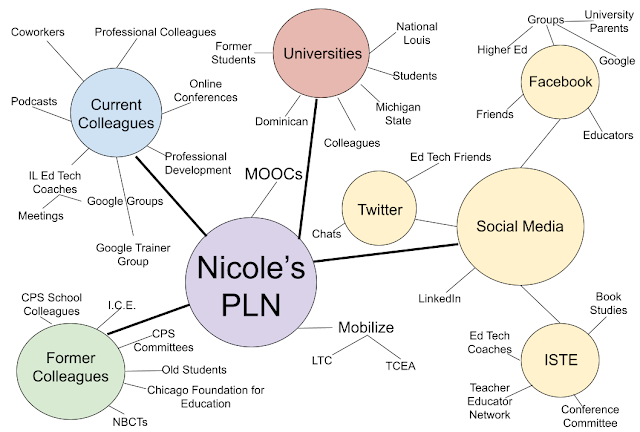
Back in January 2021 , I wrote a post about my Professional Learning Network (PLN). In this post, I mapped out who helps me grow professionally and reflected on the contents. Here is what I said then: What I Notice I have an extensive network. This may not come as a surprise to most, as I’ve been in the field for 28 years. What is significant about this, however, is that even though I have been in the field for a long time I am still learning from others, seeking help from others, and giving back to my network.  I contribute as much as I consume. For me, I see this as one of the internal traits of being an educator- to share. I often will find resources that relate to the work others are doing and will pass content on. Those who connect with me are used to my “FYI” or “Thought of You” emails with links to content I think they can use. I tend to predominately connect with colleagues who share the same viewpoints on education. This can be seen as both a positive and a negative. Given...

ChatGPT & Productive PLNs

Image
If you are in education and/or not currently living under a rock, you most likely have heard of ChatGPT. This Artificial Intelligence program has educators on their toes. The program can complete several tasks in seconds including generating essays, producing job descriptions, writing poetry, and solving coding errors to name a few. For free (at least for now).  As this controversial advancement came onto the scene, I began collecting resources. I knew coaches, fellow adjuncts, and others in education would want to acquire as much information as they could. I shared my document in a small professional learning network I belong to. One of the members of that group took the links and created a visual resource guide. The final product, found at http://bit.ly/ChatGPTinEdu has had 5,397 views in a little over a month between December 20, 2002, and January 31, 2023.  Sharing the information with my PLN initially and the resource that came out of that reinforces to me the power of P...

Examining Your Professional Learning Network

Image
This week in my CEP 810 class for Michigan State University my students are tasked with creating a concept map to examine their professional learning networks (PLNs). I’ve done presentations on this topic, advocate for and promote the power of PLNs, and contribute to mine on a regular basis so I thought this would be a good opportunity for me to update and reflect on my PLN map.  What I Notice I have an extensive network. This may not come as a surprise to most, as I’ve been in the field for 28 years. What is significant about this, however, is that even though I have been in the field for a long time I am still learning from others, seeking help from others, and giving back to my network.  I contribute as much as I consume. For me, I see this as one of the internal traits of being an educator- to share. I often will find resources that relate to the work others are doing and will pass content on. Those who connect with me are used to my “FYI” or “Thought of You” emails with...

The Importance of a PLN During a Pandemic

This webinar was given on behalf of the Learning Technology Center of Illinois.  You can watch the webinar here:  https://ltcillinois.zoom.us/webinar/register/WN_gqyqt_nqSUGZNrn0Ez-2-g

Find Your Folks: Connecting During COVID-19

Who do you call when you have news to share? Your parents? Spouse? Friends? Often, when something ‘big’ happens we have a core group to turn to for support. This is incredibly important during these uncertain times with the COVID-19 outbreak. While we no doubt are talking to those close to us (probably more than we should be) there are times when we need to talk to others who understand us in a different context. Educators around the world have been catapulted into online learning. Some are prepared and welcoming the opportunity while others are going in kicking and screaming. Although I am no longer school-based I am in the “thick of things” just like educators- only in my role, I’m supporting multiple counties, districts, and coaches. Who do I turn to for support? The following is a list of groups I’ve leaned on during these chaotic times. All are free and welcoming of new arrivals. Perhaps they will work for you too. Social Media Facebook Groups Online Learning Collective- (a group...

Mapping Digital Spaces: Where You Go Determines How You Grow (Part I)

Image
Update! See my newest map from 2025 .  I love my PLN.  As an instructional technology coach and an adjunct professor, I am continuously on the hunt for new ideas and ways to reach more students and teachers. Recently I participated in an #ISTETEN Twitter chat on Student Voices and Future Visions which included everyone from professors, coaches, teachers, and pre-service teachers.  During the chat a question was presented about student voice and what we learn when we listen to students. This led to the idea of students mapping their use of the Internet.  Some professors have students map their professional learning networks, others ask students to map digital spaces that they frequent. This idea was fascinating to me. In 2001 Marc Prensky coined the phrases "Digital Natives" and "Digital Immigrants" essentially stating that your age determined how comfortable you were with using the Internet. He explained that students born after a certain time frame were more c...

Tips to Build Your PLN

Image
This month an article that I co-wrote was published on eSchool News.  The Article is titled 7 Tips for Teachers Building Collaborate, Fearless PLNs.  To view the article online:  http://www.eschoolnews.com/2015/03/16/teachers-fearless-plns-547/ 7 tips for teachers building collaborative, fearless PLNs By Randy Hansen and Nicole Zumpano March 16th, 2015   Don’t be daunted! Try these best practices for finding and collaborating with fellow educators Ed. note : Innovation In Action is a new monthly column from the   International Society of Technology in Education   focused on exem plary practices in education. Research indicates that nearly 50 percent of educators will   leave the field within the first five years   of entering a classroom. This is an astounding number that costs the U.S. more than $2 billion annually. Why the high burnout rate? Many cite isolation and lack of support as reasons for exiting the field. Sometimes new ...

Being a Connected Educator

Image
Staying Connected  I am a connected educator.  I blog, share resources, tweet, post to Facebook, teach for three educational institutions and present at conferences to share my passion about technology in education. I ask my PLN (Professional Learning Network) for help when I need it and lend a hand when the need is theirs. Connected Educators share and learn year round but October brings extra attention to the concept. #CE14  is an international effort to connect educators that is led by the US Department of Education.  The organization does a great job of offering suggestions and activities for each day of the month.  The website contains a downloadable pdf that has daily activities for you to learn about to become more connected. Connected Educators.org  also contains a daily calendar of worldwide events that you can participate in. Why Bother? Educators are some of the most overworked folks out there (we won't even delve into the pay). So ...

Connected Educator Month

Image
http://goo.gl/712TIx Happy Connected Educator Month! October 2013 marks the 2nd annual Connected Educator Month (C.E.M.).  This initiative, sponsored by the U.S. Department of Education seeks to promote connections between educators from around the world.  Personal Learning Networks (PLNs) not only keep us current in our practice but allow us a chance to share resources and build support for each other.   There are a number of resources available to do this, even if you are new to PLNs.  Below are some examples to help you participate this month. Illinois Computing Educators (ICE) offers monthly webinars for our members.  To honor C.E.M. we are offering our webinar this month TO ALL EDUCATORS, members or not .  This month's topic is "Growing your PLN".  Register for the October 9th event here:   http://www.iceberg.org/node/281 Chicago Public Schools will have events throughout the month.  To see a list of events view the c...

Teach Your Monster to Read

Image
Original Post (see my updated post here ) I’m always on the lookout for great sites to use with students, especially the little ones.  Our students have never had “formal” technology classes and the kindergarten students had never even entered the lab.  Finding sites that are age appropriate and educational can be challenging.  “ Teach Your Monster to Read ” is a site I stumbled upon one day here .  This site, based out of the U.K. teaches beginning readers about sound and letter matching as well as blending sounds together to form words.  It uses the context of monsters going on an adventure to different magical islands (eight islands in all).  On each island there are four mini lessons that works on accuracy and speed of letter recognition. Students must complete the game sequentially.  When logged off the next time they log back in the program remembers where they were previously so they don’t have to start over.  One of the best feat...