Posts

Digital Citizenship Recommendations

Image
Although Digital Citizenship Week is celebrated in October each year this is a topic that deserves year-round attention. Recently, I crowdsourced recommendations from the coaches I work with and created an infographic of some of our favorite sites and activities to keep the learning going. 

Coach or IT Help Desk?

Image
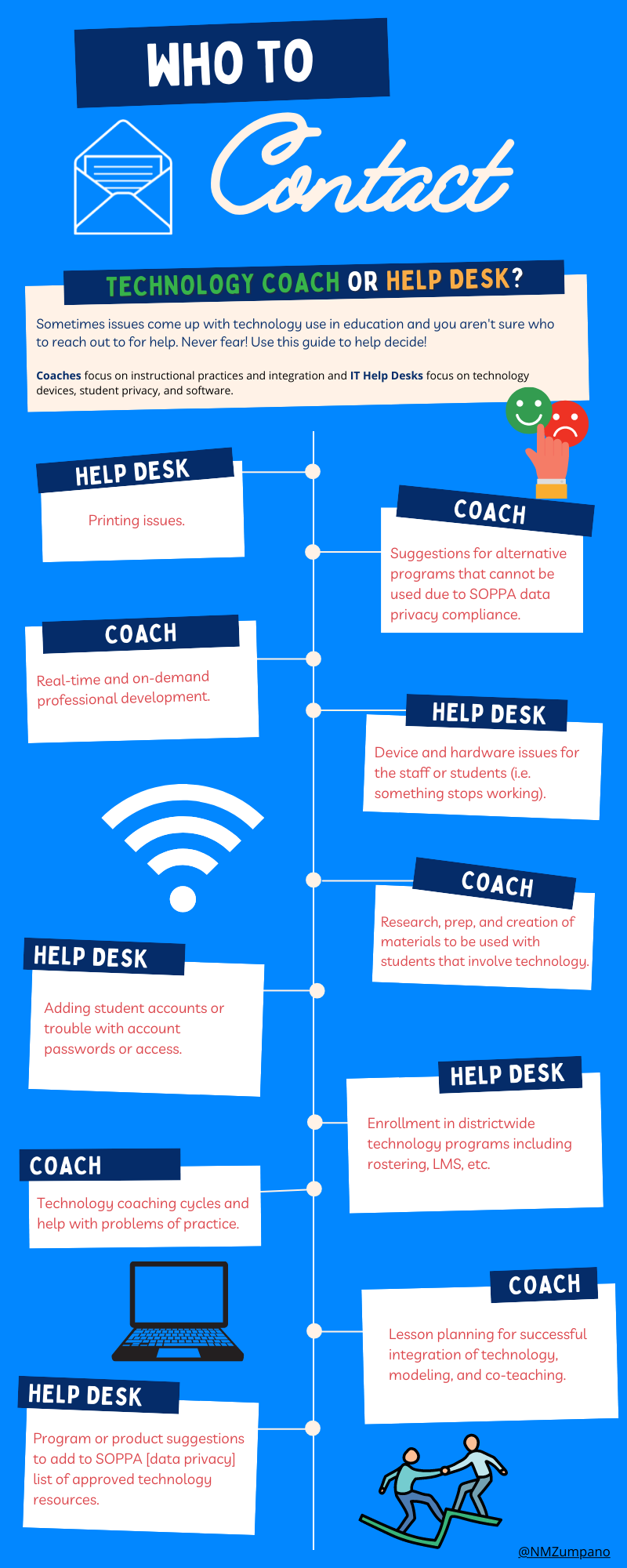
Last month during my IL Ed Tech Coaches meeting a coach inquired about anyone having a document that reflected when teachers should seek help from them vs. the school's IT help desk. No one recalled having seen such a document so we brainstormed instances where this would occur. I took the responses and made them into an easy-to-read infographic . I also shared the infographic on ISTE's community forum so my PLN could use it. The feedback was lively! It's featured below.  Original ISTE Post: In a recent educational technology coaches meeting one of the participants asked the group if we recalled seeing any documents that would explain to teachers when to go to their coach vs the IT help desk. We crowdsourced a list of instances and I created an infographic to reflect this. You can view it here: https://bit.ly/coachorhelpdesk What else would you include? Responses: I think this is a helpful visual aid and pretty spot on. I'm not sure how to incorporate it, but I think i...

Welcome, #4!

Mark McCrindle, a social researcher, and futurist states that Gen Z students will have 18 jobs over 6 different careers in their lifetime. This statistic used to shock me as I am of a different generation. For me, I've had one career: education. Within this field I've had 3 distinct jobs: teacher (both K-8 and adults), technology coach, and Regional Educational Technology Coordinator . Today, I begin job #4: Director of Instructional Technology Coaching. When I moved out of Chicago Public Schools after 25 years I stepped into a newly created role as a RETC. I loved the role and the variety of work, peers, colleagues, and topics I was able to explore. With all of this variety, I found myself continuing to gravitate toward coaches. After all, I had spent the previous 10 years as a technology coach. I hosted, attended, and co-facilitated coaching meetings around the Chicagoland area. During the school closures from COVID-19, I began hosting coaching meetings online. I created doc...

5 Ways Educators Can Get More Done in Less Time

  Written for ISTE's blog , published 4/8/21 Do you manage your time or does time manage you? The lines between work and home life have blurred over the past year of remote working conditions for many educators. The feeling of always having something to do or an email to answer can be hard to turn off. Cognitive overload is real for educators. But honing executive functioning skills will make it easier to find a balance between work and life. Here are five ways to get started.   1. Make your calendar work for you   Calendar reminders Many calendar applications allow for more than scheduling video conferencing meetings. The calendar application within my productivity suite allows me to set “reminders” for myself. The significance of this is that unless I hit “mark as done” or delete each note, these reminders stalk me throughout the week by bumping to the next day like a digital tap on the shoulder. Think ahead When scheduling a meeting a week or more in advance,...

5 Things Students Should Do to Stay Safe and Secure Online

 Happy #SaferInternetDay! This is a reprint of a blog post originally written for ISTE . As adults, we do everything possible to keep our computers, bank accounts and families safe. Our list of  to-dos  continues to grow as our use of digital technologies increases. While these tasks are rote to most adults, we can’t expect that our students will follow our lead.   It is our responsibility as educators to make sure learners know how to do more than surf the web and consume media. All educators — from classroom teachers to technology coaches and school administrators — should lead the discussion on digital literacy. Here are some ways to make sure our students  stay safe and secure online : Teach students to conduct data mines (on themselves). Students should do this every 3-6 months. While many will Google their names, we need to teach them to dig deeper. Here are some general guidelines to follow: Log out of internet browsers before searching (staying...

Examining Your Professional Learning Network

Image
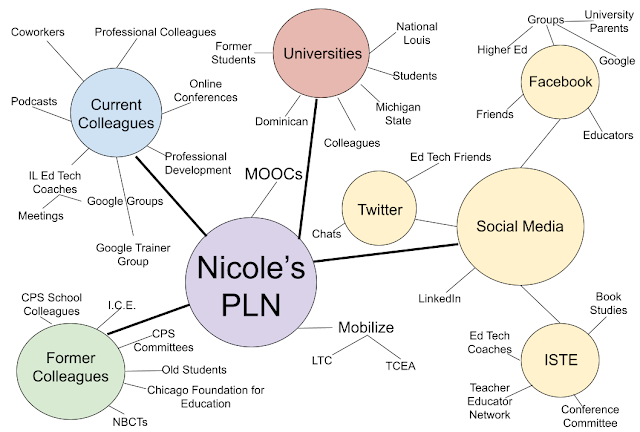
This week in my CEP 810 class for Michigan State University my students are tasked with creating a concept map to examine their professional learning networks (PLNs). I’ve done presentations on this topic, advocate for and promote the power of PLNs, and contribute to mine on a regular basis so I thought this would be a good opportunity for me to update and reflect on my PLN map.  What I Notice I have an extensive network. This may not come as a surprise to most, as I’ve been in the field for 28 years. What is significant about this, however, is that even though I have been in the field for a long time I am still learning from others, seeking help from others, and giving back to my network.  I contribute as much as I consume. For me, I see this as one of the internal traits of being an educator- to share. I often will find resources that relate to the work others are doing and will pass content on. Those who connect with me are used to my “FYI” or “Thought of You” emails with...

Hour of Code 2020

 Check out this great document that was developed by some fantastic coaches I work with!